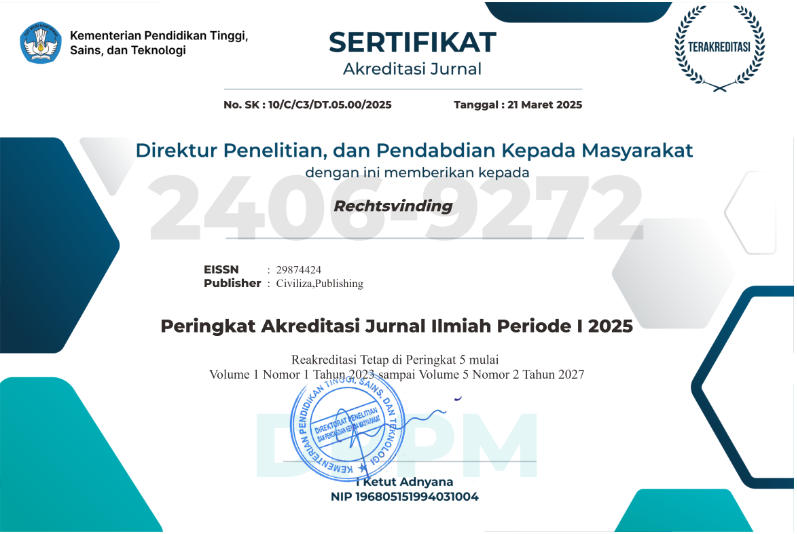
From Party Autonomy to Algorithmic Autonomy: Reconstructing the Principle of Freedom of Contract in Artificial Intelligence-Generated Contracts
DOI:
https://doi.org/10.59525/rechtsvinding.1971Keywords:
algorithmic autonomy, artificial intelligence generated contract, freedom of contractAbstract
The increasing use of artificial intelligence in drafting, reviewing, and negotiating contracts challenges the traditional conception of freedom of contract, which is founded on the autonomous will, informed consent, and equal bargaining position of the contracting parties. This study examines whether contracts generated or substantially shaped by artificial intelligence can still be regarded as genuine expressions of party autonomy and seeks to reconstruct the principle of freedom of contract in response to the emergence of algorithmic autonomy. The research employs a normative legal method using statutory, conceptual, and comparative approaches, supported by an analysis of contract law doctrines, electronic transaction regulations, and contemporary principles of artificial intelligence governance. The study finds that an artificial intelligence-generated contract may remain legally valid when the system functions merely as an instrument acting within parameters determined by legally competent parties. Nevertheless, formal consent alone is insufficient to demonstrate genuine contractual freedom when parties do not understand the operation of the artificial intelligence system, the origin of the generated clauses, or the legal risks arising from algorithmic errors, bias, and unequal technological capacity. The study proposes a reconstructed model of freedom of contract based on meaningful human control, informed algorithmic consent, transparency regarding the use of artificial intelligence, the ability to review and modify generated clauses, and clear attribution of responsibility for technological errors. It concludes that algorithmic autonomy should not replace party autonomy but must remain subordinate to human intention, fairness, accountability, and the protection of contracting parties.
References
Agustianto, A., & Situmeang, A. (2025). Legal validity of smart contracts for investment purposes: Analysis of Indonesia’s legal politics and emerging challenges. Masalah-Masalah Hukum, 54(2), 269–282. doi:10.14710/mmh.54.2.2025.269-282
Busch, C. (2025). Consumer law for AI agents. German Law Journal, 26(7), 1367–1382. doi:10.1017/glj.2026.10188
Cumyn, M. (2025). Standard form contracts and the erosion of consent: Is there no turning back? The American Journal of Comparative Law, 73(1), 129–163. doi:10.1093/ajcl/avaf016
Fairfield, J. A. T. (2014). Smart contracts, Bitcoin bots, and consumer protection. Washington and Lee Law Review Online, 71, 36–53.
Frattone, C. (2023). Algorithmic mistakes in machine-made contracts: The legal consequences of errors in automated contract formation. Uniform Law Review, 28(3–4), 407–425. doi:10.1093/ulr/unae004
Herbosch, M. (2023). Contracting with artificial intelligence: A comparative analysis of the intent to contract. Rabels Zeitschrift für ausländisches und internationales Privatrecht, 87(4), 672–706. doi:10.1628/rabelsz-2023-0076
Kurniawijaya, A., Yudityastri, A., & Zuama, A. P. C. (2021). Pendayagunaan artificial intelligence dalam perancangan kontrak serta dampaknya bagi sektor hukum di Indonesia. Khatulistiwa Law Review, 2(1), 260–279. doi:10.24260/klr.v2i1.108
Latifiani, D. (2020). Renewal of the national contract law. Jurnal Hukum Progresif, 8(2), 137–150. doi:10.14710/jhp.8.2.137-150
Mik, E. (2022). Much ado about artificial intelligence or: The automation of contract formation. International Journal of Law and Information Technology, 30(4), 484–506. doi:10.1093/ijlit/eaad004
Noto La Diega, G., & Bezerra, L. C. T. (2024). Can there be responsible AI without AI liability? Incentivizing generative AI safety through ex-post tort liability under the EU AI Liability Directive. International Journal of Law and Information Technology, 32, eaae021. doi:10.1093/ijlit/eaae021
Nurzaman, J., & Fidhayanti, D. (2024). Keabsahan kontrak yang dibuat oleh artificial intelligence menurut hukum positif di Indonesia. Al’ Adl: Jurnal Hukum, 16(1), 140–159. doi:10.31602/al-adl.v16i1.12710
Oliver, M. (2021). Contracting by artificial intelligence: Open offers, unilateral mistakes, and why algorithms are not agents. Australian National University Journal of Law and Technology, 2(1), 45–87.
Raskin, M. (2017). The law and legality of smart contracts. Georgetown Law Technology Review, 1(2), 305–341.
Ridwan, A. S. Y., & Rusdiana, S. (2018). Kebebasan memilih pihak dalam kontrak pada asas kebebasan berkontrak dalam sewa menyewa kamar tinggal. Jurnal Hukum IUS QUIA IUSTUM, 25(1), 115–136. doi:10.20885/iustum.vol25.iss1.art6
Rosadi, S. D., & Tahira, Z. (2018). Consumer protection in digital economy era: Law in Indonesia. Yustisia Jurnal Hukum, 7(1), 85–97. doi:10.20961/yustisia.v7i1.20144
Savelyev, A. (2017). Contract law 2.0: “Smart” contracts as the beginning of the end of classic contract law. Information & Communications Technology Law, 26(2), 116–134. doi:10.1080/13600834.2017.1301036
Scholz, L. H. (2017). Algorithmic contracts. Stanford Technology Law Review, 20(2), 128–169.
Seele, P., Dierksmeier, C., Hofstetter, R., & Schultz, M. D. (2021). Mapping the ethicality of algorithmic pricing: A review of dynamic and personalized pricing. Journal of Business Ethics, 170(4), 697–719. doi:10.1007/s10551-019-04371-w
Surden, H. (2012). Computable contracts. UC Davis Law Review, 46(2), 629–700.
Tan, C.-H. (2025). COVID-19, agentic artificial intelligence and contract formation. The Chinese Journal of Comparative Law, 13, cxaf009. doi:10.1093/cjcl/cxaf009
Tejomurti, K., Sukarmi, & Mahmudy, W. F. (2025). Legal challenges and reform proposals for algorithmic contracts under Indonesia’s Information and Electronic Transactions Law. Jambura Law Review, 7(2), 559–582. doi:10.33756/jlr.v7i2.30617
Werbach, K., & Cornell, N. (2017). Contracts ex machina. Duke Law Journal, 67(2), 313–382.
Downloads
Published
How to Cite
Issue
Section
License
Copyright (c) 2026 Chandera Halim

This work is licensed under a Creative Commons Attribution 4.0 International License.