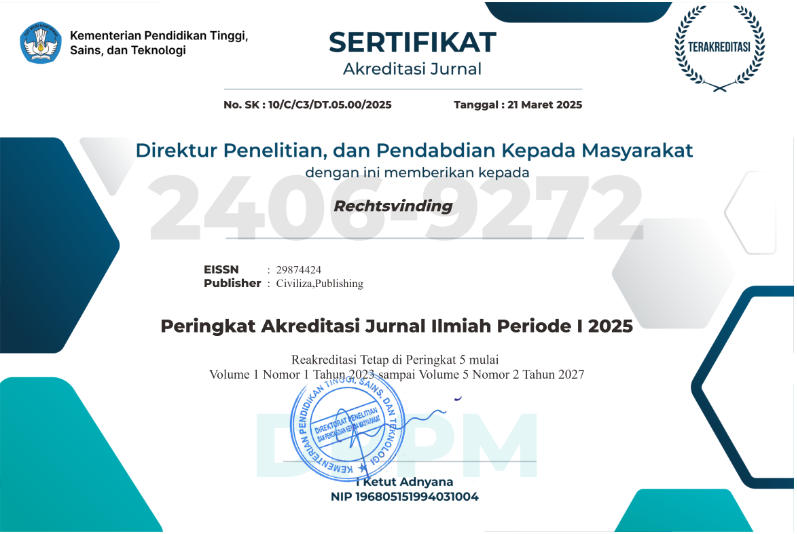
The Use of Electronic Evidence in Divorce Cases Due to Allegations of Domestic Violence at the Pematangsiantar Religious Court
DOI:
https://doi.org/10.59525/rechtsvinding.2058Keywords:
evidence; electronics, DivorceAbstract
The development of information technology influences the evidentiary process in divorce cases, including those involving allegations of domestic violence. Digital communications, photos, videos, voice recordings, and electronic documents can record relevant facts, but their use still faces issues of authenticity, integrity, and evidentiary strength. This study analyzes the normative provisions, evidentiary strength, obstacles, and solutions for the use of electronic evidence in divorce cases at the Pematangsiantar Religious Court. This research is a holistic normative study with a prescriptive-analytical nature using the Theory of Evidence, the Theory of Legal Certainty, and the Theory of Legal Protection. Data analysis was conducted deductively-qualitatively. The results of the study indicate that electronic evidence has a valid legal basis, but its evidentiary strength depends on its authenticity, integrity, relevance, and connection with other evidence. Decision Number 129/Pdt.G/2024/PA.Pst demonstrates a formalist approach by rejecting the strength of electronic evidence that is not supported by expert examination, while Decision Number 63/Pdt.G/2025/PA.Pst demonstrates a contextual-integrative approach by positioning electronic evidence as preliminary evidence that can be corroborated by other evidence. This difference demonstrates the need for clearer assessment parameters and proportional expert examination.
References
Art, SM, et al. (2024). Regulation of electronic evidence as an instrument of proof in the settlement of civil disputes through rechtsvinding by judges. Citizenship Journal, 8(1), 698.
Adinda, FA, Rahmawati, E., Suparman, E., & Woodward, J. (2026). The practice of using electronic evidence in civil procedure law: Obstacles and challenges. Lex Scientia Law Review, 10(1), 67–100. https://doi.org/10.15294/lslr.v10i1.21889
Jamaludin, J., & Kusumah, HA (2026). Lacuna juris in evidence of domestic violence crime under the new Indonesian Criminal Procedure Code: A juridical analysis of digital evidence, single witness, and post mortem et repertum parameters. International Journal of Law and Society, 3(4), 1–11. https://doi.org/10.62951/ijls.v3i4.989
Mintarsih, M., Gayo, A., Suhariyanto, B., Rafsanjani, JI, Anggayudha, ZH, Farhana, F., Untoro, U., & Trisista, RGM (2026). Critical analysis on legal protection for victims of online gender-based violence in Indonesia: Viewed from its effectiveness and recommendations. Violence Against Women. Advance online publication.https://doi.org/10.1177/10778012261432624
Saputra, I., & Maysarah, A. (2026). Implementation of digital forensics in proving cybercrime at the Medan District Court. Warta Dharmawangsa Journal, 20(1), 416–430. https://doi.org/10.46576/wdw.v20i1.8264
Harahap, (2017). Civil procedural law on lawsuits, trials, confiscation, evidence, and court decisions. Sinar Grafika.
Hasnawati, & Safrin, M. (2023). The position of electronic evidence in proving criminal acts. Al-Manhaj: Journal of Islamic Law and Social Institutions, 5(2), 1212.
Ibrahim, J. (2008). Normative legal research theory and methodology. Bayumedia Publishing.
Supreme Court of the Republic of Indonesia. (2022). Regulation of the Supreme Court of the Republic of Indonesia Number 7 of 2022 concerning amendments to Regulation of the Supreme Court Number 1 of 2019 concerning electronic administration of cases and trials in court. Supreme Court of the Republic of Indonesia.
Supreme Court of the Republic of Indonesia. (2023). Circular Letter of the Supreme Court Number 3 of 2023 concerning the implementation of the formulation of the results of the plenary meeting of the Supreme Court chamber in 2023 as a guideline for the implementation of duties for the court. Supreme Court of the Republic of Indonesia.
Constitutional Court of the Republic of Indonesia. (2016). Decision Number 20/PUU-XIV/2016. Constitutional Court of the Republic of Indonesia.
Manurung, ER, Naldo, RAC, & Pasaribu, MPJ (2025). Application of criminal responsibility to children. FOCUS, 6(1).https://doi.org/10.37010/fcs.v6i1.1865
Napitu, PE, Naldo, RAC, & Pasaribu, MPJ (2024). Effectiveness of implementing sanctions based on Article 38 of Law Number 16 of 2009 for taxpayers. Jurnal Ilmiah Advocacy, 12(2), 252–264.https://doi.org/10.36987/jiad.v12i2.5527
Naldo, RAC, Pasaribu, MPJ, & Pasaribu, TW (2025). Misuse of Taxpayer Identification Numbers in Business Transactions. Nas Media Pustaka
Nasution, S.I., Rizkan Zulyadi, M.C.R., Pinem, S., & Meher, M. (2025). The impact of globalization on human smugling and economic policy responses. Unissula Faculty of Law Journal, 41, 821–841
Pematangsiantar Religious Court. (2024). Decision Number 129/Pdt.G/2024/PA.Pst.
Pematangsiantar Religious Court. (2025). Decision Number 63/Pdt.G/2025/PA.Pst.
Republic of Indonesia. (1974). Law Number 1 of 1974 concerning marriage.
Republic of Indonesia. (1974). Law Number 1 of 1974 concerning marriage as amended by Law Number 16 of 2019.
Republic of Indonesia. (2008). Law Number 11 of 2008 concerning Electronic Information and Transactions.
Republic of Indonesia. (2009). Law Number 48 of 2009 concerning judicial power.
Republic of Indonesia. (2016). Law Number 19 of 2016 concerning amendments to Law Number 11 of 2008 concerning Electronic Information and Transactions.
Republic of Indonesia. (2024). Law Number 1 of 2024 concerning the second amendment to Law Number 11 of 2008 concerning Electronic Information and Transactions.
Republic of Indonesia. (nd). Civil Code.
Syaputra, MYA, & Lubis, MA (2023). Constitutional law. This work is also recorded in the repository of the University of Medan Area.
Soekanto, S. (1986). Introduction to legal research. UI Press.
Sunggono, B. (2001). Legal research methods: An introduction. RajaGrafindo Persada.
Susylawati, E. (2015). The position of electronic evidence in proving divorce cases. Journal of Islamic Social and Religious Sciences Research, 12(2), 290.
Downloads
Published
How to Cite
Issue
Section
License
Copyright (c) 2026 Al Zimy Siregar, Rony Andre C. Naldo, Muldri PJ Pasaribu

This work is licensed under a Creative Commons Attribution 4.0 International License.